Aamchi Mumbai: Chai-Shai/ Our Mumbai: Tea and all that
Our “Aamchi Mumbai” collection is a celebration of all things typically Mumbai in character. Prints and patterns that pay tribute to simple, everyday objects that have become somewhat of an institution representing this great city. Probably the most prominent is cutting chai or masala chai. Found at every street corner and every train stop, this thick, milky tea is the fuel that this city runs on. The indispensable chaiwallah or tea-maker is a prominent feature on the streets of Mumbai. Infinitely more popular than coffeehouses of the west, the chaiwallahs provide the masses with their daily caffeine fix. Forget about your lattes and frappucinos, all you need here is the sweet and spicy concoction called chai. Amidst the hustle and bustle of city life, the network of chaiwallahs work tirelessly to make the delicious beverage that keeps the city functioning. The clink of glasses and the call of the chaiwallah are the sounds of much awaited relief for the hard-working denizens of Mumbai. The chaiwallahs have become the symbol of a city built on toil and one that thrives on its guilty pleasures.


Although “chai” is now a term that most caffeine aficionados are familiar with, chances are you’ve never had a cuppa quite like this one. So who better to help us unravel the secrets of masala chai than a true-blue Mumbai chaiwallah. We set off with our little reporter’s notebook and found a chaiwallah willing to tell us his story and let us in on his secret recipe!
Ramesh Ghadshi has been a chaiwallah since he can remember. His father worked at a chai centre and when he would get done with school for the day, Ramesh would stop by to help out- being a chai-runner of sorts, delivering chai to regular customers. He watched his dad stir the large vessel of steaming tea, intermittently adding a cardamom pod, a sprinkle of pepper and other aromatic spices. When he was old enough, he started his own little tea stand outside Bandra Station, in the suburbs of Mumbai, where he provided much-needed refreshment to the hard worn commuters. Business was good, as thousands of people rushed to and from work at this busy terminus. As he eloquently puts it, his life moved in fast forward and he lived out a few years in what felt like just a few months.
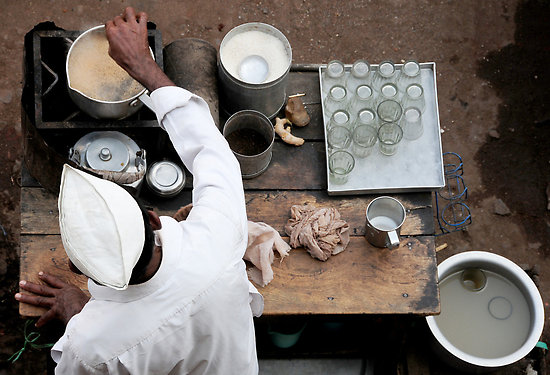
But he wasn’t the only one with the same idea. Soon there was too much competition in the form of bigger and badder tea-centres, serving everything from masala chai to triple-decker sandwiches. So he moved his tea stand to a residential neighbourhood where his main clientele now consists of chauffeurs, maids, security guards and cooks from the affluent apartments near-by. He says that though he now has only a fraction of the customers that he did before, he is much happier here as he has made good friends and is enjoying the escape from the frantic pace of Mumbai life. We were inclined to agree as he has staked out a prime location in the posh Pali Hill area, under the shade of a Copper Pod tree that scatters its delicate yellow flowers around the tea stand and occasionally in your tea.
As for interesting experiences as a chaiwallah, he can’t recall any but says that he always gets a kick out of tourists, college students and sometimes residents of the neighbourhood visiting his stall to get the authentic experience of cutting chai. They giggle and whisper excitedly as they watch him make the tea and are perpetually awestruck when he reveals that a glass of his delicious tea will set them back a mere six rupees (incidentally a rupee more than he charges his regulars!).

After much cajoling we managed to get him to tell us his recipe for the perfect masala chai. Bring equal amounts of water and milk (full fat for the best experience) to the boil and add a teaspoon or two of loose leaf tea. Black tea is the tea of choice here. Add the chai masala and copious amounts of sugar and allow to simmer. Strain and serve. Every chaiwallahs masala mix is different, but Ramesh uses a mix of cardamom, ginger, black pepper and cloves. Occasionally, when he is in an exceptional mood, he says that he adds a dash of lemongrass. Throughout the day his vessel of tea simmers on the stove and he continuously replenishes it with fresh ingredients.

Probably the most popular symbol of cutting chai is the small, patterned glass it is served in. Also, there is amazing skill involved in stretching the tea between two large cups in order to cool it! In the Southern parts of India, tea is knows as three-foot tea, five-foot tea etc., depending on the number of feet is has fallen during the cooling and mixing process done by a chaiwallah in India.

No comments:
Post a Comment